Googling for Bitcoin

Cryptocurrency is a hot topic right now. While still a relatively new idea, its legitimacy is such that the word has even been added to the Oxford English Dictionary. There are more than 275 different currencies as of May 2014, and Bitcoin first and foremost, with a market cap of more than $6.2B.

The fluctuating price of Bitcoin has made it a source of much speculation, with some advocates saying it is here to say, while others are more skeptical.

A major point of concern amongst the naysayers is that it’s a bubble, that the currently volatile price may one day fall to nothing.  Indeed that was our concern at Simeon Capital when we first considered Bitcoin.  However once we dug around, we found a way to guarantee that the price would keep going up and up: Google.

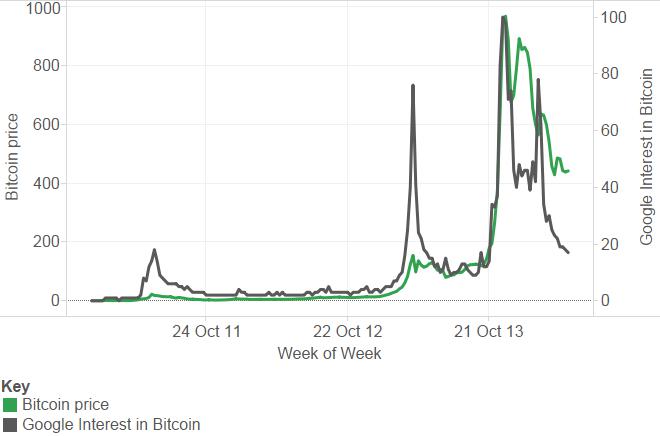
As part of our Bitcoin due diligence, we were trying to piece together the key drivers of Bitcoin price.  One of our favourite research tools is Google trends, and upon downloading the trend data for Bitcoin, we were astonished to learn that the weekly price of Bitcoin moves almost perfectly with the level of Google interest in Bitcoin.

Bitcoin testThe implications are clear – the more times people Google “Bitcoin”, the higher the price per Bitcoin. Indeed, according to our proprietary regression analysis, the level of Google interest in Bitcoin is able to explain more than 70% of the weekly price of Bitcoin!

Upon seeing this, we of course acted quickly, purchasing millions of dollars of Bitcoin, and walls and walls of computer servers. We are currently in the final stages before the search-launch, when we will effectively triple the number of “Bitcoin” Google searches, which according to our analysis should add an incremental $1000 to the price of Bitcoin in one fell swoop!

So buy yourself some Bitcoin, and fire up Firefox.  We are long in Bitcoin, and our wealth is only limited by our Googling capability.  I’m feeling lucky.

(Graph created with Tableau, Sources: Google Trends, Coinbase)

Tagged , , , , , , , ,

Graduate applies for non-dream job

A recent university graduate has left onlookers puzzled, after she applied for a job role that was not a key part of her life plan.  Felicity Sawyer, 21, applied for a place on Deloitte’s Risk Consulting graduate scheme, despite the fact that she had only recently heard of Deloitte, let alone Risk Consulting.

“I don’t know, it seemed like a good idea at the time,” explained Felicity.  “I graduated last year, and didn’t have any plans, so went travelling for a few months.  When I got back my parents told me I needed to get a job, so I just applied to the first thing I came across.”

Such a glib approach to application left the HR team at Deloitte dumbfounded.  “We were shocked, I must say,” said Deloitte’s recruiting representative.  “The majority of applicants for this program have wanted to work for Deloitte as a Risk Consultant since they sprung into the world, so to have such a misguided, last-minute application left us quite frankly appalled.”

Felicity’s parents, Mel and John, were embarrassed at the whole situation. “We didn’t realise she had gone so far off the rails.  When we told Fi to follow her dreams, we presumed she understood that meant building your life plan around a specific graduate role at one of the Big Four.”

So pastures new, for Felicity.  She was upbeat when we left her.  “I still don’t really know what Risk Consulting is, to be honest.  I think I’d much rather start writing some kind of business satire blog.  I’m sure there’s lots of money in that.”

Tagged , , , ,

Bank of England interest rates remain low

The Bank of England released its quarterly inflation report this week, prompting much discussion in the Square Mile. There had been speculation in the City that interest rates would rise, however the Old Lady of Threadneedle Street soon put those rumours to rest.

“While there are some who believe that the general public’s interest in the state of the economy should be increased, that is not our current objective,” the Bank explained. “While the economy is on the road to recovery, at the moment we are keen to keep the public’s awareness and interest in economics as low as possible.”

The general population’s interest in the world of finance is currently been at an all time low, having fallen to 0.5% in 2009, staying at that level ever since. This sudden decrease was the result of a concerted effort among money-makers to distract the man on the street from what was going on. “With Lehmann and the whole sub-prime thing, we honestly had no idea what we were doing,” reports one industry insider. “We thought that the best thing to do was to make everything about the economy as boring and un-interesting as possible.” This strategy was a great success, allowing the banking industry to get back to business as usual.

When you look at the data over a longer time period, it is clear that this decrease is not just a one-off, with the decrease in general interest in the economy part of a larger trend.

(Created with DataWrapper, Source: Bank of England)

Official Bank of England figures indicate that interest has fallen from 10-15% in the 70’s and 80’s, to the low single digit numbers that we see today. Economist Henry Kelsey-Wilkinson believes that this is due to the range of other more interesting things on offer in the modern world. “In the 80’s, there honestly wasn’t that much going on, so reading about GDP and FDI didn’t seem like such a bad thing. These days the FT is up against Netflix, and there’s only one winner in that fight.”

However regardless of the underlying reason, the fact remains that interest rates are staying low in the near future. Governor Mark Carney had the last word: “We continue to think that interest rates will remain on hold until the second half of next year, later than the markets and most economists expect.”


Tagged , , , ,

Entrepreuninsight: Wikiwordia

I love Wikipedia.  There I’ve said it.  While it may be dismissed out of hand in academia, for the everyman it has become an indispensable tool, primarily when it comes to avoiding ridicule. Where actually is Budapest?  Wikipedia. What does FIFO stand for, again?  Wikipedia. Who on earth is Thomas Piketty? All together now, Wikipedia.

However as useful as Wikipedia is, I soon found that it had its limits.  While it is able to tell you who Sepp Blatter is (a Swiss football administrator), in doing so it relies on words to communicate meaning.  I found myself thinking, what if I didn’t understand words?  How would I possibly even use Wikipedia?  I myself would sometimes not know the meaning of a word in a Wikipedia entry (e.g. administrator), leaving me feeling lost, confused, and unable to find the meaning of that word anywhere on Wikipedia!

It was this mixture of general concern and personal experience that inspired me to start Wikiwordia – Wikipedia, but for the words of Wikipedia. While this may be a startling concept, it has caught popular imagination, and new users have been joining at a rate of knots.

Far from a competitor, Wikiwordia is the perfect companion for Wikipedia.  If you are stumped for the meaning of a word, our Wikiwordia app can tell you what that word means.  For example if, while browsing through Wikipedia pages, you come across a difficult word like “Dictionary” in Samuel Johnson’s entry, and can’t quite recall that word’s meaning, simply click on it, and Wikiwordia’s API interfaces automatically with Wikipedia to help you out (indeed I must do so myself!  Words are tricky, aren’t they?)

As well as constantly refining the app, and most importantly building up an exhaustive list of Wikinitions based on our own proprietary research, we are also constantly building out additional services, in response to requests from our users.  For example we are currently developing sub-app-app Wikiwikiwordia, for those people who don’t understand words they find in Wikiwordia.

Like Wikipedia, Wikiwordia is a non-profit.  Where Wikipedia “exists to bring knowledge to everyone who seeks it”, Wikiwordia exists to bring knowledge of the words of Wikipedia to everyone who needs it.  With your help and continued support, I hope that we can do that.

Tagged , , , , , ,

Business is war: Leading from the Front

The comparison of business to the art of war is often made, drawing on the experience of dead generals to address commercial problems.

While there are some aspects of war that I would certainly not inflict upon my coworkers (e.g. slaughter, copious blood), I have often found these comparisons ring true.  In this post I will discuss how applying military thinking has helped my business succeed.

One of the key components of leadership is how you are perceived by your followers – are you a strong, confident person? Or are you shy and retiring, afraid of the fight?

Hard as it may be to believe, 10 years ago I was once very much in the former camp, at least in the eyes of my team.  I spent hours poring over the literature, desperate to discover what was lacking  It soon became clear to me – I was not leading from the front.

Being the first to enter the fray is an often-used way in which military figures gain respect from their soldiers, and I found the same to be true in business.

Instead of walking to meetings willy-nilly, I began to have my teams walk behind me, in formation. When sitting at a boardroom table, I would place my seat 2 feet in front of everyone elses. In all conversations I would make sure to have the first word, and never the last.  The results were remarkable.  I was suddenly spoken to differently, by both my team and my clients.  Where previously I had been a person, I was now a leader.

I quickly reorganized the whole way we did business. I placed my office at the front of the building, with all other desks behind mine. I installed an entrance such that I could walk in backwards, ensuring that I never have any member of my organisation behind me, always leading from the front. I haven’t seen any of my co-workers’ faces in years, and business is booming. If you lead from the front maybe yours will too.

Tagged , , , , , ,

Pfizer offer fails to impress AstraZeneca

UK business news is awash with Pfizer’s thus far unsuccessful attempt to purchase fellow pharmaceutical company AstraZeneca.  The US Viagra manufacturer’s latest bid of £63B left the AstraZeneca board unimpressed.

AstraZeneca are reportedly keen to do the deal, with an insider reporting that “this is on Pfizer to get the price up.  I know they’re 165 years old, but that’s no excuse, we’re an attractive asset.  They’ve got to do better than that”

Called upon for comment, a Pfizer board member was just confused.  “This has honestly never happened to us before.  We’ve never had stage fright, and we’ve made lots of acquisitions.”

Meanwhile some onlookers are more long-termist, concerned as to whether Pfizer are really in for a serious commitment, with both MPs and Unions demanding guarantees that Pfizer will protect jobs and research spending in the UK, and not just leave in the morning.

Talks continue in earnest.

Tagged , , , , , , , , ,

Less meeting, more doing

In the early years of my career I seemed to spend all my days in meetings, one after the other from nine to five.  In general a lot was said, but all too often I found that too little was achieved, with the resultant verbatim Minutes document a poor substitute for the actual minutes lost along the way.

The potential people-hour cost of meetings has been noted elsewhere, with Harvard Business Review estimating recently that one company’s weekly meeting was taking up 300,000 people-hours per year!

This frittering of time always bothered me, with so much time spent merely meeting people, most of whom we probably already knew!  That is why in 2009, when I was in a more senior position, I implemented a seismic change in my company’s working culture, transitioning from Meetings to Do-ings.

While this may appear to be a basic change in company lexicon, it actually had a profound effect on the daily productivity of the business.  Suddenly the focus was on what would be done, as opposed to who would be there.  Where previously we were emphasizing the communal aspect, we were now all about what would be achieved while we were together.

This cultural change organically developed, altering the whole Do-ing occasion within the business.  Where previously we received meeting invites, we started receiving Do-vites.  Conference calls became Done-ference calls, and Minutes became Done-things.  With each definitional change, we saw a boost in our KPIs, from employee productivity to operating margin.

While we do still spend lots of time together discussing things as a team, we are no longer wishing the time away.  So perhaps next time you find yourself confronted with a directionless meeting agenda, you might move your focus from Meeting to Doing.

Tagged , , , , , ,

Apple invests in growth with acquisition of Beets

Apple’s acquisition of Beets by Dre was widely rumoured in the blogosphere and the press, and the sale was drunkenly confirmed by Dre in a video posted on Tyrese Gibson’s Facebook page.

This has sparked a wave of articles across the internet on the exact rationale behind the acquisition. While some pundits are skeptical about the deal, in this onlooker’s opinion it is a sound business decision.

Apple is one of the most popular fruits in the world, with 250 million bushels produced in the US alone; the average person in the United States consumes approximately 10 pounds of fresh Apple per year.

It has also successfully built on the fruit itself, introducing Apple Juice and Cider as apple based drinks, and bringing out a number of related products, such as Apple Crumble.

However in recent times it has struggled to replicate its former growth, with consumers increasingly steering clear of high-sugar juices, while Banana has taken Apple’s spot as the most consumed fresh fruit.

As a result the pressure is on Apple to innovate, which has perhaps been the motivating factor behind this recent deal.

The deal is certainly unprecedented – this is the first time that Apple has acquired another food-type, let alone one with Beets’ scale.  However the formerly under-appreciated Beetroot is a hot-topic in the industry, as its numerous health benefits come to the fore, from blood pressure to cancer-protection; Beets even improve running times!

It is this that piqued Apple’s interest, as Beets are a solid bet going forwards, with a long runway of future growth as people become increasingly health-conscious.  In addition, Farmer Dre will be joining Apple as a senior executive, and will bring the company a youthful cool, which has perhaps been lacking in the last few years.

So while it may not be to everyone’s taste, this is a good decision for Apple in the long run, though your correspondent certainly hopes that there will be no Apple/Beet flavour combinations as a result.

Tagged , , , , , , ,

Making small business more like big business

Google was founded in 1998.  Facebook was founded in 2004.  In a world that has been transformed by companies that are younger than the legal drinking age, the startup has gained an almost mythical quality, with even the most cursory of Google searches yielding multiple articles encouraging  startup behaviour in larger, more established companies. Large companies with paltry single digit revenue growth are clamouring for startup gold dust, rethinking strategy, R&D and even hiring policy along the way.  However I am here to argue that the opposite should be taking place – why aren’t more startups acting like multibillion dollar corporations?

This may be against the currently held wisdom, but the numbers back it up.  Forbes’ top 10 companies in 2013 made c. $175B in profit last year, while most startups don’t even generate any revenue.  The latest and greatest startup tech companies might be valued in billions, but Walmart’s market capitalization is c. $250B.  So why on earth are business gurus imploring these leaders of industry to imitate their lesser cousins?  The sooner early-stage companies start to act like big corporate, the better.

As an entrepreneur, how is it best to go about this startup transformation?  The first step is obvious, which is to focus on shareholder value at all times.  While your shareholders are probably limited in number (indeed it might just be you), that doesn’t mean you shouldn’t adopt this crucial tenet of big business.  It doesn’t matter if your lead developer’s latest idea could get you 100,000 new users, what does that mean in terms of market capitalisation?  It doesn’t matter if a new idea might change the way in which people interact online – if it doesn’t increase your shareholders’ dividend then you don’t want to hear it.  These things are important to big business, and as an aspiring big business, they are therefore important to you.

Having realigned your company’s focus, the next thing to do is to introduce some bureaucracy.  Big corporate has lots of hierarchy, and so should you.  Establish a layer of managers between you and your front-line workers.  Hire some managers to manage those managers, with management team leaders to oversee it all.  Introduce committees, bringing in people with disparate views, interests and competencies.  Make sure that all decisions have multiple stakeholders, with diverse and vested interests.  Only then will your startup start to mimic the dynamism of big business.

When hiring your myriad management structure, the approach is well-established – competency-based questions. Often startups focus a lot on company fit, and technical skills, when they should in fact be worrying about times their employees have historically dealt with conflict.  What about your employees’ self-reported track record when it comes to team-work, and overcoming difficult problems?  I, for one, would never hire anyone who couldn’t give me two examples of times when they have implemented change in their organisation.  I would strongly recommend that you don’t either.  Rely on competency-based questions, and you will get the loyal foot-soldiers your company needs.

Having established your structure, and hired your employees, how should you go to work?  The key is to be as prescriptive as you possibly can.  Some foolish startups encourage “free time” and “employee creativity”.  This is to be discouraged, as it wastes valuable company time, and company time is company money, and company money is shareholder value.  Lest you even consider wasting shareholder value, I will refer you to my first point – Shareholder Value, Shareholder Value, Shareholder Value.  If you focus on that, you won’t go far wrong.

These changes may all seem large scale, and fundamental, and that is because they are.  But if you are serious about making your business a big business, they are changes that you will do well to make, and you will surely be glad when you have done so.
 

Tagged , , , , ,

Amazon change photography game

Amazon have done it again.  First, they revolutionized the world of retail by bringing the store to the consumer.  Now they have finally overcome photography’s greatest conundrum – how to take a photograph of an object in front of a white background without leaving a shadow, with a patent approved by the US Patent Office.

This will have drawn sighs of relief from the photography industry, as well as from the world of fashion, where back-drop shadow puppets have long plagued designers’ shoots, and e-commerce, where unsightly shadows in the background of product-shots have historically made consumers reluctant to buy online.

Amazon’s move here is business done right – finding solutions to pressing problems, and filing them appropriately with the regulatory authorities so as to monetize them effectively.  Needless to say photographers worldwide will be paying Amazon a huge debt of gratitude, on top of the obligatory license payment whenever they take a shadow-free photograph against a white background.


Tagged , , , ,