Author Archives: hardlybusiness

Business Interest: Suggestion #3

HBR has written previously about the current low rate of interest in the UK’s economy.  In this series, HBR investigates the British public’s lack of interest in the subject, and tries to work out what is best to do about it

The internet age has changed the way people consume information. Where previously the power was in the hands of the producer, on the limitless internet it is now the end user of information who is in control. With endless topics to choose from, the coronation is now complete; the consumer is king.

In this consumer-centric world, an article’s title has become all the more important. Description is no longer sufficient; now one must be titillated or intrigued to be persuaded to click through. People also love lists.

Despite this new world order, the business world has not yet cottoned on, with the same old descriptive, informative headlines being rolled out. Only today, example headlines included such drones as “Lloyds fined £218M over Libor”, and “Prudential Regulation Authority consults on implementing the Bank Recovery and Resolution Directive”.

I’m sorry, I think I just briefly drifted off. That simply won’t cut the mustard! Here are some suggestions for business headlines that will give business interest the bump it deserves:

  • Bank fined How Much for dodgy banking practices?
  • The Prudential Regulation Authority had a pow-wow. What they found will SHOCK you
  • What it really means to be the Bank of England
  • Doctors hate this business cost saving. Find out why
  • Please don’t make this common emerging economy mistake
  • Undeniable proof that dividends are interesting
  • Which multinational conglomerate are you?
  • 13 marketing hacks that YOU need to know
  • This Mom found a new way to analyse equities
  • 17 insults bankers are tired of hearing
  • 61 things you didn’t know about the inflation (and I’m not talking about balloons)
Tagged , , , , , , , ,

Conference call goes smoothly

Teams from both sides were left puzzled today after a conference call went off without a hitch. The interim meeting between Simeon Partners, a consultancy, and their client Organic Taste Foods was scheduled to take place over the phone, and the conference call went perfectly.

“I’m gobsmacked to be honest,” said Simon Chambers, of Simeon Partners. “I knew something was up when everyone dialled into the conference call successfully and on time, but I never would have guessed that everyone would actually be audible, let alone that no one would talk over one another.”

Organic Taste Foods were similarly surprised. “There were no crossed wires at all, we understood just what they meant, first time. I found myself hissing down the phone to make up for the lack of distracting background noise!”

We contacted Audiomax, the conference call operator, who said that their engineers are looking into the issue.

Tagged , , ,

Coffee and Negotiation

In business, a common misconception is that negotiation is a discrete occurrence, materializing only occasionally. While it is certainly true that there are times when negotiation is very much the focus, such as discussions around sales terms or promotions, every business day is peppered with smaller negotiations.

Similarly everything you do influences the way you go about those negotiations, from your appearance to the coffee you drink. How does your Starbucks order impact your negotiation style?

Filter Coffee – you are a straight shooter, and just want to get it done. And also you just want caffeine now, thanks very much.

Espresso – you are intense, to the point, and people often mispronounce your name. You might be short in stature, but you pack a mean punch.

Frapuccino – you are not well respected as a serious negotiator, but secretly everyone loves you, and will get you what you want when nobody is looking.

Iced Skinny Flavoured Soy Latte – you want all the bells and whistles, but you would like them to be ethically sourced. You have no problem broadcasting your many talents and selling yourself, nor making your companions wait while the barista carefully drops organic ice cubes into your drink.

Hazelnut Macchiato – you are what you are, and you’re not afraid to show it. Not everyone will agree with you all the time, and some might wonder why you’re calling it a coffee at all, but you normally get what you want.

Flat White – you didn’t want to win this negotiation particularly, but you heard everyone else wants to, so you thought you would too.  You don’t really know what it entails, but it sort of tastes nice.

Double Espresso – you are a madman with no regard for human life.

Tagged , , , ,

Business Interest: Suggestion #2

HBR has written previously about the current low rate of interest in the UK’s economy.  In this series, HBR investigates the British public’s lack of interest in the subject, and tries to work out what is best to do about it

Spoiler – a description of an important plot development in a television programme, film, etc. before it is shown to the public

People love spoilers.  There is something about finding something out ahead of time that is both intoxicating and attractive. If an article says “Spoiler alert”, I will read it even if I don’t watch the television programme it relates to!

Why are keen business minds not making the most of this magnificent tool? All too many financial articles start with something dreary, perhaps along the lines of “Industrial output” or “Fed bond”. That’s just not going to get bums on seats! Open with an enticing “Spoiler alert:”, circulation will jump and interest in business will soon follow.

Tagged , , , , , ,

Outbreak of workplace friendship

A London investment firm has been incapacitated by an outbreak of friendship. Simeon Partners, an alternative asset management company, alerted the authorities as soon as the infection was detected.

“We didn’t hesitate,” explains Partner Jim Bonham, “we know how dangerous workplace friendship can be, so immediately took steps to combat further spread.”

It soon became clear that the root of the problem was amongst new members of the Grad scheme. Despite trying to interact exclusively as detached professionals, trainees Peter Finch and Nicholas Ince accidentally got to know one another beyond the usual workplace pleasantries. Given its infectious nature, friendship quickly spread, and soon a number of the graduates began to like each other as people, not merely assessing each other as productivity centers.

HBR spoke with Peter: “I’m not sure how it started, but stilted small talk became meaningful conversation, and we began to talk about things we actually cared about. When we realized it was happening it was already too late.”

It wasn’t long before multiple members of Simeon were going out for non-compulsory after-work drinks, and even seeing each other at the weekend. Friends and family were quick to express their concern, with Nick’s girlfriend particularly perturbed. “It just seems weird to me, choosing to spend time with your colleagues when you don’t absolutely have to,” she explained.

Simon Hodgson, Managing Partner at Simeon, says that the main issue is that due protocol was not followed. “In the event of a friendship in the workplace, our HR policy requires those involved to communicate it, which did not happen in this case. We were left with no choice”. For the time being, the relevant parties have been quarantined in an attempt to suppress further spread, but Snapchat communication is proving problematic, with the Grads communicating extensively via a range of Emojis.

“Who knows,” wonders Simon, “they may actually form a meaningful lifelong friendship, after meeting as colleagues. I hope not for their sake though, what an embarrassing story to tell the grandkids.”

Tagged , , , , , , ,

Hawthorne Helpdesk bans Facebook

Employees at Hawthorne Helpdesk had reportedly been spending too much time on social media and streaming videos, prompting management to block the websites altogether.

“It’s a real pain, actually,” explains Account Executive Harry Simkins. “I used to spend about 60 percent of my time trolling people on Youtube comment threads, but now username 14yroldboybutbetterthanyou is lying dormant.”

However rather than the boost in productivity that management hoped for, the move has actually just increased the range of online extra-curriculars. “It’s so annoying, I’ve been forced to start reading improving articles just to get through the day,” says Executive Assistant Amy James. “I’ve even started taking Mandarin courses, when all I want to be doing is judging my friends’ beach bodies on Facebook.  Those mean comments won’t write themselves”.

The change has had severe negative effect on some members of the office. Sales rep Jim Wilson has been particularly struggling. “I’m becoming so well rounded as a person,” he tells HBR, “I’ve completely lost the ability to do banter with the boys. If I learn another useful and interesting fact I think I’ll go mad.”

Tagged , , , , , , ,

Business Interest: Suggestion #1

HBR has written previously about the current low rate of interest in the UK’s economy.  In this series, HBR investigates British public’s lack of interest in the subject, and tries to work out what is best to do about it

In the previous post we confirmed that the British public has only a passing interest in business.

Having identified the symptoms, a wise and careful doctor would reflect on his medical training, perhaps consult a textbook or two, in order to come to a diagnosis. Not just what, but why the people of the UK are not engaged.  Why do they not appreciate the cruel beauty of capitalism, or at least the many iPads that commerce has created?

However that seemed like far too difficult a question for a Tuesday evening, so on this occasion we will skip diagnosis, and start prescribing right away, the business equivalent of the frustrated GP’s immediate antibiotics course.

Today’s suggestion is actually a simple one, and it’s all about wording. When I wake up and consider my morning cornflakes, I am in something of a sensitive state, in both mind and body. If I am perusing a paper, the last thing I want to be digesting (even mentally) is anything that might be considered disgusting, let alone gross, lest I see my cornflakes for a second time.

It is for that reason that I propose that the Gross Domestic Product (whose naming I have never understood) is changed forthwith to the Delicious Domestic Product. Meanwhile GDP’s unsightly cousin Gross Profit is immediately to become Sumptuous Profit, an altogether more delectable prospect.

In one fell swoop the readership of the morning business section will rise, interest rates will move in step, and we are off the mark.

Tagged , , , , , , , , ,

Business Interest: the Research

HBR has written previously about the current low rate of interest in the UK’s economy.  Indeed the Bank of England’s current strategy is to keep it that way, at least until the money men work out what on earth they are doing.  In this series, HBR investigates the low rate of interest in the British economy amongst the general public, and tries to work out what is best to do about it.

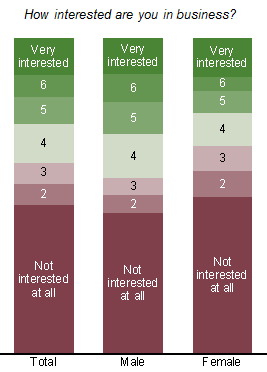
The first step, of course, is primary research.  The bank announces the interest rate on a regular basis, but we very rarely get to see the data behind the press releases. How do we know that Carney et al have got their sums right? Are the people of Britain actually very interested in business after all? Thankfully, the wonderful people at Google have given the man on the street a means by which to canvas other men on the street, the Google Survey.  We asked 350 UK internet browsers how interested they were in Business, on a scale of 1 to 7, and this is what we found:

Survey results (UW)Crikey, that’s a lot of information! How do we read that? Well the first thing to note is that a large chunk of the population is not at all interested in business, so our friends at the Bank of England are not wrong. And it looks like men are more interested in business than women. Now that is interesting, I hear you murmur.  Misogynists will be nodding approvingly, while national programs will be launched to get our girls more interested in business. Maybe this is why the boards of the UK are so bereft of female directors?

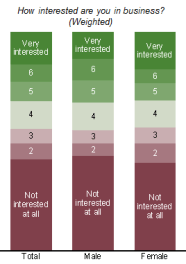
But wait just one gosh-darned minute.  Because this column is not just a shrine to silly business satire, it is also a place where we care about proper data analysis. Because there is a problem in the raw data that Mr Google provided me with, in that the sample is not representative of the overall population.  And in fact, if you weight the data appropriately, this is what you get:

Survey results (W)Now that’s more like it.  Once again, it looks like overall no one is that interested in business (40% totally uninterested overall!), but this time round women are actually even more interested than men in business, so pipe down misogynists. What is really going on here? It turns out that the problem was that our sample contained a disproportionate number of older women, and age is actually the area where you start to see differences between respondents:

Age


The chart above shows the percentage selecting 6 or 7 (i.e. very interested), vs. the percentage selecting 1, or not interested at all, and isn’t it interesting? Older people are the most uninterested, while the most interested people are aged 25-34. Obviously the question is whether that means interest rates will naturally rise as people get older, or whether people just lose interest as they get older. Either way that is some intriguing information.

So what have we learnt? We have learned to avoid sexist stereotypes, because ladies love business, and we have learnt that data always tells the truth, except when it doesn’t.  We have learnt that the youth of today aren’t so indifferent after all. And finally, the Old Lady of Threadneedle Street has been spot on, as when it comes to business, interest rates in the UK remain low.

Hat tip: Google Surveys

Tagged , , , , , , , , ,

Business is Awesome: Slides

Business is Awesome.  You know it, I know it.  This series is where I write about it.

I was talking to an old classmate of mine the other day, who works at a strategy consulting firm.  We were catching up on the usual topics, when we started talking about his job, and what he does on a day to day basis. Now I thought consulting was a desk job, but I was amazed to discover he actually spends his entire time making slides.

Imagine that! We didn’t have time to get into the details (I’m not sure if it’s water slides, or just regular adventure playground slides), but that sounds great to me. I’ve always been a big fan of slides of all shapes and sizes, particularly the ones that drop immediately down, or “death slides”, as we used to called them. I was always terrified beforehand, but glad when I did them, you know?

Anyway, apparently they make slides using a “Power-Point” machine, and ultimately it all goes into Slide Shows in the end.  I’ve never been to a Slide Show before, but they sound like a lot of fun. I’ll be sure to go to one, but not before I’ve applied to join a consulting firm. Spending all day making slides? Business is awesome.

Tagged , , , , , ,